
D&T Safety Partnership
A structured approach to workshop safety, training and maintenance throughout the year.
Introducing the D&T Safety Partnership Scheme
Schools often address workshop safety only when a concern arises. This can lead to large amounts of training being arranged at short notice, disruption to teaching, and significant one-off costs. Individual consultancy days can be effective, but they often come as a reactive response rather than part of a planned approach.
The D&T Safety Partnership Scheme is designed to provide a more structured and supportive alternative. Instead of arranging isolated training days, schools work within a planned programme across the year, with agreed dates and predictable costs.
While much of the training delivered through the partnership focuses on health and safety, it is always linked directly to real classroom practice. By understanding the projects your department runs and the schemes of work you teach, training can focus on the specific machines, tools and processes your pupils actually use.
This ongoing partnership also allows support to extend beyond safety training when needed. Sessions can focus on areas such as introducing new specifications, supporting staff transitioning into workshop teaching, or ensuring that equipment and machinery are properly maintained.
The aim is to move workshop safety from being an occasional concern to becoming a planned, integrated part of how the department operates throughout the year.
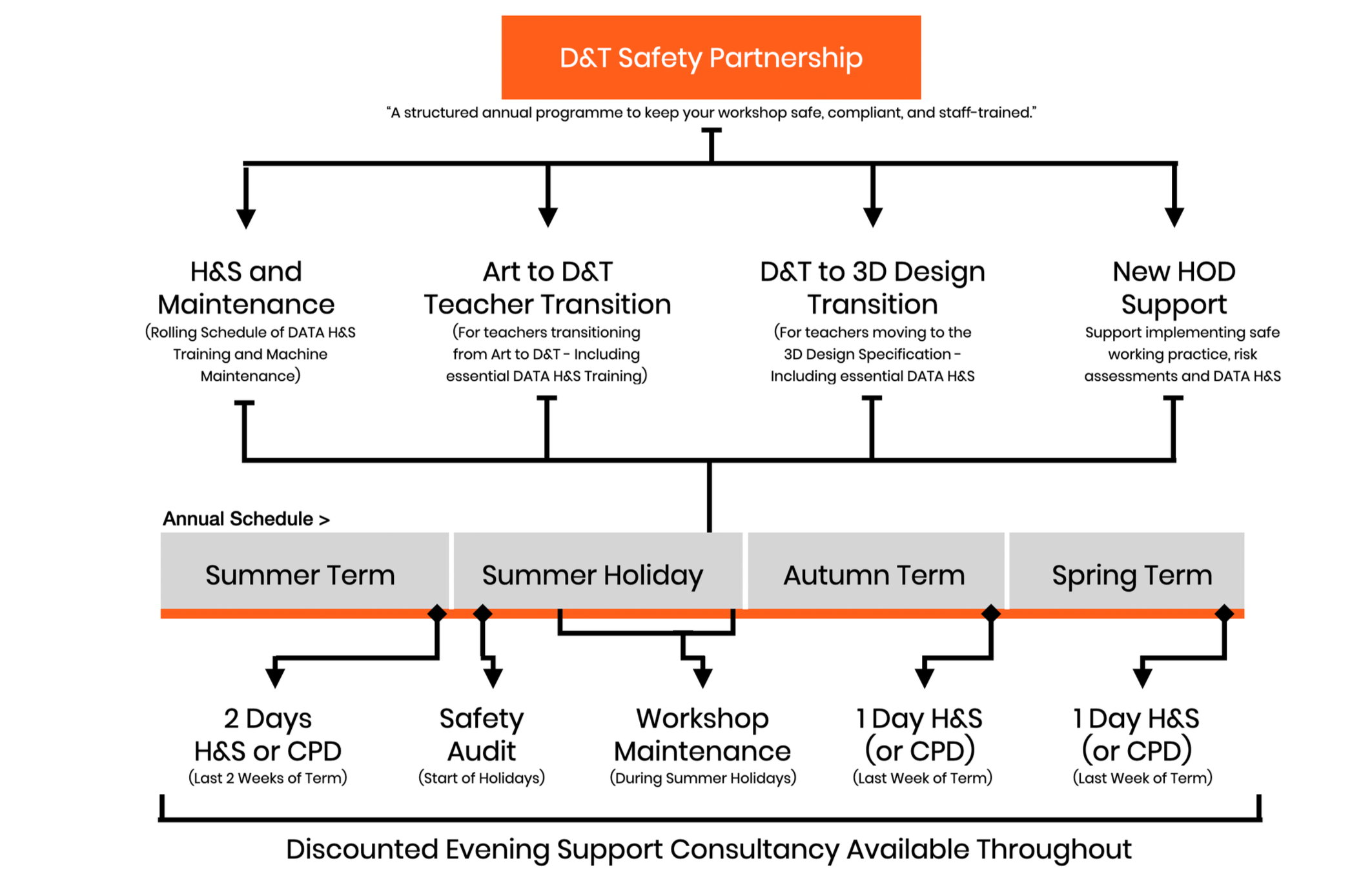
1) Choose the focus that fits your department
The partnership is tailored around one (or a blend) of the following needs:
H&S and Maintenance – a rolling schedule of staff training alongside workshop checks and planned maintenance.
Art to D&T Teacher Transition – support for teachers moving into workshop-based teaching, including essential safety training linked to the projects they will deliver.
D&T to 3D Design Transition – support for departments moving towards a 3D Design route, ensuring safe practice remains embedded while teaching and assessment approaches change.
New Head of Department Support – practical help putting robust systems in place: safe working practice, risk assessment routines, staff competence tracking and workshop organisation.
2) A planned annual schedule
The partnership is delivered through a predictable cycle across the year:
Summer Term (last two weeks of term)
You receive two days of H&S or CPD. This is typically used to build staff confidence before the summer break and to prepare for any changes to projects, staffing or workshop routines for the year ahead. Where appropriate, this can include targeted training for new staff or teachers transitioning into D&T/3D workshop practice.
Summer Holiday (start of holidays)
A Safety Audit is carried out at the start of the holidays. This provides a clear snapshot of current workshop practice and identifies any actions needed. Schools typically use this audit to set priorities for the year ahead and to ensure any issues are addressed before students return.
Summer Holiday (during the holidays)
Workshop Maintenance is scheduled during the holiday period, allowing machines to be checked and adjusted without disruption to teaching. Where required, maintenance can be linked directly to the findings of the audit so that any practical issues are resolved while the workshop is quieter and access is easier.
Autumn Term (last week of term)
You receive one further day of H&S (or CPD). This is often used as a mid-year check-in: refreshing safe working routines, addressing any new staff needs, or tightening up practice once the year is underway.
Spring Term (last week of term)
A final one day of H&S (or CPD) provides a spring review point, supporting consistency and ensuring staff remain confident and current in workshop safety practice. This is also a good point in the year to refine paperwork, routines and supervision approaches ahead of summer practical work and assessment deadlines.
3) Training that links directly to teaching
Where the partnership includes CPD, it is assumed that much of it will be safety-led, but delivered through real classroom practice. That means training is shaped around:
the projects you actually run,
the machines and processes pupils are using,
and the way your department teaches and assesses practical work.
Over time, this approach allows training to be more specific, more relevant, and far easier to embed than a one-off generic session.
4) Discounted evening support throughout the year
Alongside the scheduled days, partner schools have access to discounted evening support consultancy throughout the year. This is designed for the kinds of issues that don’t justify a whole day but still need expert input — for example, quick guidance on safe practice, troubleshooting workshop routines, or targeted support with a specific machine/process.
5) Clear outcomes and documentation
The partnership is designed to leave schools with clear, usable outputs rather than vague advice. Depending on your school’s priorities, this may include:
an audit summary with recommended actions,
a training record for staff sessions delivered,
and a plan for maintenance and follow-up items.
This helps departments demonstrate a structured approach to workshop safety and staff competence over time.
6) Cost Effective
The partnership is also designed to be a cost-effective alternative to reactive consultancy. When safety concerns arise unexpectedly, schools often end up booking multiple training days in quick succession, which can be disruptive to teaching and difficult to budget for. By planning support across the year, departments can spread training, review and maintenance in a manageable way while avoiding the need for last-minute intervention.
A structured programme also allows training and support to be more targeted and efficient. Because time is spent understanding how your department works — including the projects taught, machines used and staff experience — sessions can focus on the areas that genuinely need attention rather than repeating generic guidance. This makes each visit more valuable while helping departments maintain safe and consistent workshop practice over time.
Get In Touch